

White papers
Stay up to date on the latest topics and gain industry insights from HMS' experts through our white papers, providing valuable knowledge and analysis.
Building a state-of-the-art monorail in Saudi Arabia requires precision, connectivity, and collaboration. Discover how EIS Automation made it happen using the Anybus Wireless Bolt.
EIS Automation is based in Las Vegas, Nevada, and specializes in modular robotic systems for manufacturing. With a strong focus on Windows-based machine control and data management, the company typically delivers standardized pick-and-place robotic work cells.
Its systems are deployed worldwide through customer exports, with installations spanning Argentina, China, Europe, and Australia.
The monorail project began with a chance encounter at an Industry 4.0 event, where Josh Watson was a keynote speaker. After his speech, he was approached by the president of Innova Technologies, a structural engineering firm based in Las Vegas. Innova was leading the development of a monorail system in Riyadh, Saudi Arabia, and needed a way to automate the measurement of monorail beams during construction in the King Abdullah Financial District.
As Josh says: “At the time, we didn’t know exactly what they wanted to do, but we know sensors, we can do electrical engineering, we’re experts at motion control and Windows application development. If the customer had the patience and the budget, we had the skills to make good things happen.”
Traditional surveying methods relied on oversized calipers, which are time-consuming, risky, and imprecise. So, EIS was tasked with creating a state-of-the-art system that could:
• Autonomously travel along monorail beams.
• Collect high-precision data on beam width, squareness, and elevation.
• Operate reliably in extreme heat.
• Enable remote configuration and data access without internet connectivity.
• Minimize hardware footprint and support field deployment.
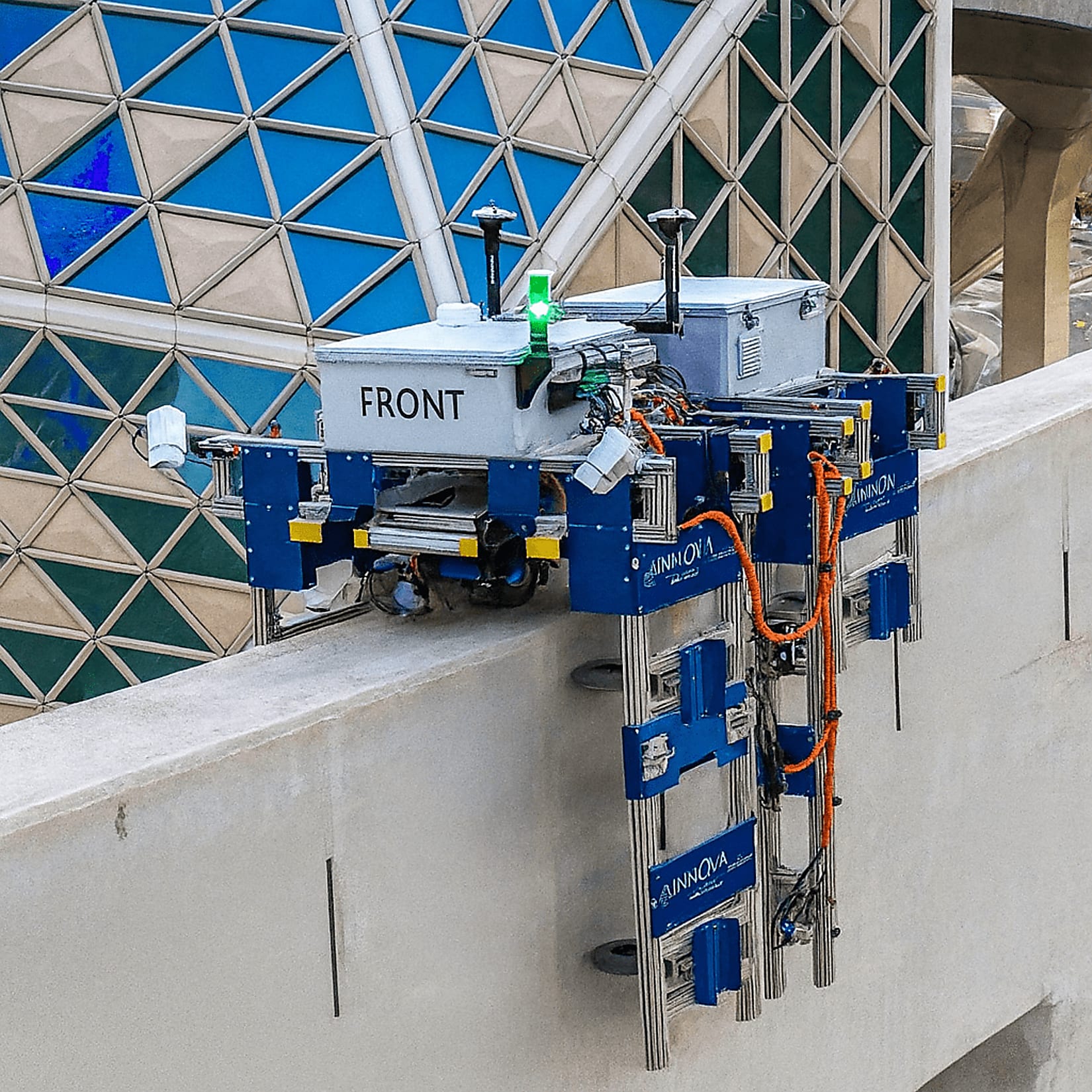
In monorail terminology, the track is referred to as a “beam.” The Beam Measurement Device (BMD) developed by EIS autonomously travels along these beam segments, collecting data in 5mm increments using:
• Six laser profilometers to measure surface geometry
• Two accelerometers for motion tracking
• Two high-precision GPS antennas with 10mm accuracy
• An industrial PC running custom .NET C# software
• A touchscreen interface for local interaction
The system creates a 3D profile of each beam segment, capturing width, squareness, and super elevation. This data is used for construction validation and can also support future maintenance inspections.
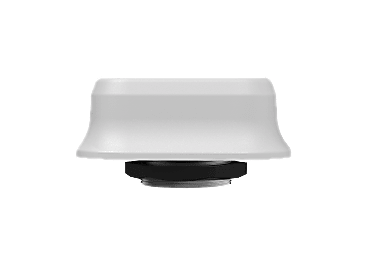
To enable wireless configuration, control, and data download, EIS integrated the Anybus Wireless Bolt II in Access Point mode. This allowed laptops and tablets to connect directly to the BMD, acting as remote HMIs.
Installation was straightforward: the Bolt was mounted externally on the control enclosure, requiring only a 50 mm cutout. This saved valuable cabinet space and eliminated the need for separate antennas or DIN rail-mounted components. Currently, 4G connectivity is achieved using a cell phone. In future deployments, the cell phone won’t be required as an Anybus Wireless Bolt LTE will be used, which offers integrated cellular connectivity.
• BYOD functionality: Operators could use handheld devices to configure and monitor the system.
• Easy access to data: After each run, collected data was downloaded wirelessly for analysis and processing.
• Space-saving design: Its compact form factor eliminated the need for internal cabinet space or separate antennas.
• Reliable performance in extreme heat: Maintained stable connectivity even during daytime operation in 44°C conditions.
• Enhanced safety: Used to configure the first line of defense—setting the BMD to stop after a specified distance.
• Future-ready: EIS plans to upgrade to the Anybus Wireless Bolt LTE for cellular connectivity in upcoming deployments.
The project was a complete success and highlights the benefits of having helpful partners, especially when tackling something new. As Josh explains, “This was a unique project for us, and the Anybus Wireless Bolt played a critical role. We used the Bolt to configure the system, control it remotely, and download data after each run. And because it mounts externally, it saved us valuable cabinet space. The BYOD setup worked well, we could log in with a laptop or tablet and get what we needed without extra hardware. This really is a unique project. This is the only device in the world like it, and it’s fulfilled a very specific use case in the transportation industry”.
And will EIS continue to use Anybus products when the need arises? “We’ve used Anybus products for years, and we’ll definitely continue to do so, especially with the LTE version for future global deployments”
For more information, visit www.hms-networks.com/anybus, www.eisautomation.com, and innovanv.com
Company: EIS Automation and Innova Technologies
Country: Developed in USA, deployed in Saudi Arabia
Year: 2025
Solution: Wireless/Cellular infrastructure
Industries: Modular robotic systems
Products: Anybus Wireless Bolt II
Stay up to date on the latest topics and gain industry insights from HMS' experts through our white papers, providing valuable knowledge and analysis.

Our products solve everyday industrial communication problems. Discover how our customers have improved their business with HMS case studies.
HMS communication solutions help thousands of companies solve specific communication problems in many different industries and applications.